Agent architecture
Define the agent role, inputs, outputs, allowed actions, blocked actions, handoffs, memory rules, escalation paths, and success metrics.
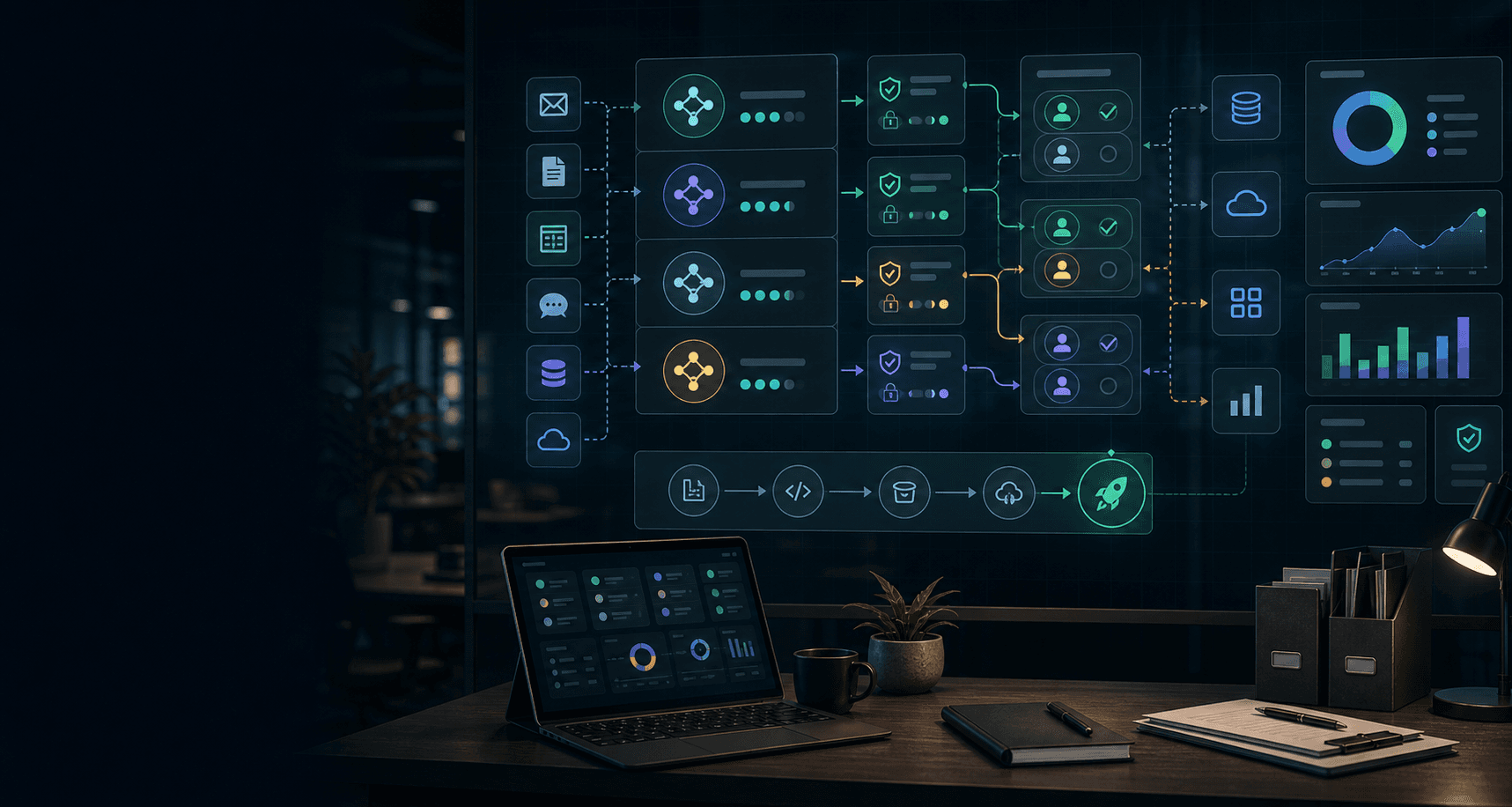
AI automation service
AI agent development services for custom workflow agents, tool access, integrations, approval queues, guardrails, testing, monitoring, and ROI.
Buyer intent
Many custom AI agent projects start as impressive demos and fail when they meet real permissions, messy data, approvals, edge cases, and system ownership. The risk is building a broad agent before the job, tools, guardrails, and human review path are clear.
Deliverables
Every engagement is scoped around concrete work products, clear owners, and decisions your team can review.
Define the agent role, inputs, outputs, allowed actions, blocked actions, handoffs, memory rules, escalation paths, and success metrics.
Connect approved sources such as email, CRM, ERP, helpdesk, documents, spreadsheets, forms, calendars, APIs, and vertical systems with least-privilege access.
Add permission gates, confidence handling, source evidence, review queues, blocked action rules, fallback behavior, and audit logging.
Test messy examples, measure output quality, track exceptions, monitor cost and latency, review user corrections, and tune the agent after launch.
Implementation path
Each service starts with the workflow, then narrows into data, approvals, implementation, and measurement.
Choose one agent job: Start with a repeated workflow such as request triage, document review prep, customer reply drafting, CRM update prep, evidence gathering, or approval packet creation.
Design context and permissions: Specify what the agent can read, what it can draft, what it can never do, which tools it can call, and when a human must approve the next step.
Build in review mode: Develop the agent with test cases, source links, approval queues, handoff rules, logging, and failure handling before any broad production rollout.
Launch and improve: Use real corrections, exception rates, reviewer feedback, adoption signals, and ROI reporting to tune prompts, tools, permissions, and workflow boundaries.
Buyer checks
High-intent buyers should be able to compare scope, pricing, guardrails, and risk language before booking or approving implementation.
Before buying AI agent development services, confirm the exact workflow, owner, source systems, sample records, manual volume, and approval risk.
Separate consultation, audit, implementation, integrations, software, managed support, and change-request cost before comparing proposals.
Require allowed actions, blocked actions, approval-required decisions, source evidence, fallback paths, and audit logs before production launch.
Compare the proposal language against public AI risk, security, and implementation references without treating them as a substitute for expert review.
Fit and proof
Use these signals to decide whether a workflow has enough value, repeatability, and control points to automate.
The business has a repeated workflow, clear source systems, review owners, measurable outcomes, and enough volume to justify a custom agent.
The team wants a general autonomous agent without a named workflow, tool boundaries, owner group, approval rules, or measurable business result.
The agent reliably prepares work, exceptions are visible, humans approve risky steps faster, and monitoring shows fewer manual touches over time.
FAQ
Short answers for buyers comparing AI automation options, risk, and implementation scope.
AI agent development services design and build custom workflow agents that can read approved context, use tools, prepare outputs, route exceptions, and support business operations with human approval guardrails.
Development focuses on the agent role, tool access, prompts, permissions, testing, and guardrails. Implementation connects the agent into the live workflow, review queues, integrations, monitoring, and ROI reporting.
Common systems include email, forms, CRM, ERP, helpdesk, document storage, spreadsheets, calendars, databases, APIs, webhooks, ticketing systems, and industry platforms.
Use narrow roles, least-privilege access, source evidence, blocked actions, approval queues, fallback paths, test cases, audit logs, monitoring, and staged expansion based on real usage.
Decision support
Buyers can compare how the work is planned, priced, governed, and started before booking a consultation.
Workflow guides
Matched workflow pages help buyers see where this service turns into practical implementation.
Build AI email workflow automation for shared inbox triage, message classification, attachment context, reply drafts, owner routing, approval guardrails, and SLA reporting.
Customer SupportCustomer Support AI Workflow AutomationBuild customer support AI workflow automation for ticket triage, SOP lookup, reply drafts, escalation routing, approval guardrails, and ROI reporting.
Document OperationsAI Document Processing Workflow AutomationBuild AI document processing workflow automation for document intake, classification, extraction, validation, review queues, system updates, and audit logs.
MSP / IT ServicesMSP Ticket Triage and RMM Alert AI Workflow AutomationBuild MSP ticket triage and RMM alert AI workflow automation for PSA tickets, device context, backup failures, endpoint warnings, patch queues, dispatcher review, and ROI reporting.
Start scoped
The strongest first step is a narrow workflow with clear owners, accessible data, approval rules, and a measurable ROI baseline.