Quality queue
Capture inspection notes, defect evidence, and corrective-action tasks.
Manufacturing operations
Automate manufacturing teams: quality control, nonconformance routing, maintenance work orders, inventory exceptions, production scheduling, approval logs, ROI, and pricing.
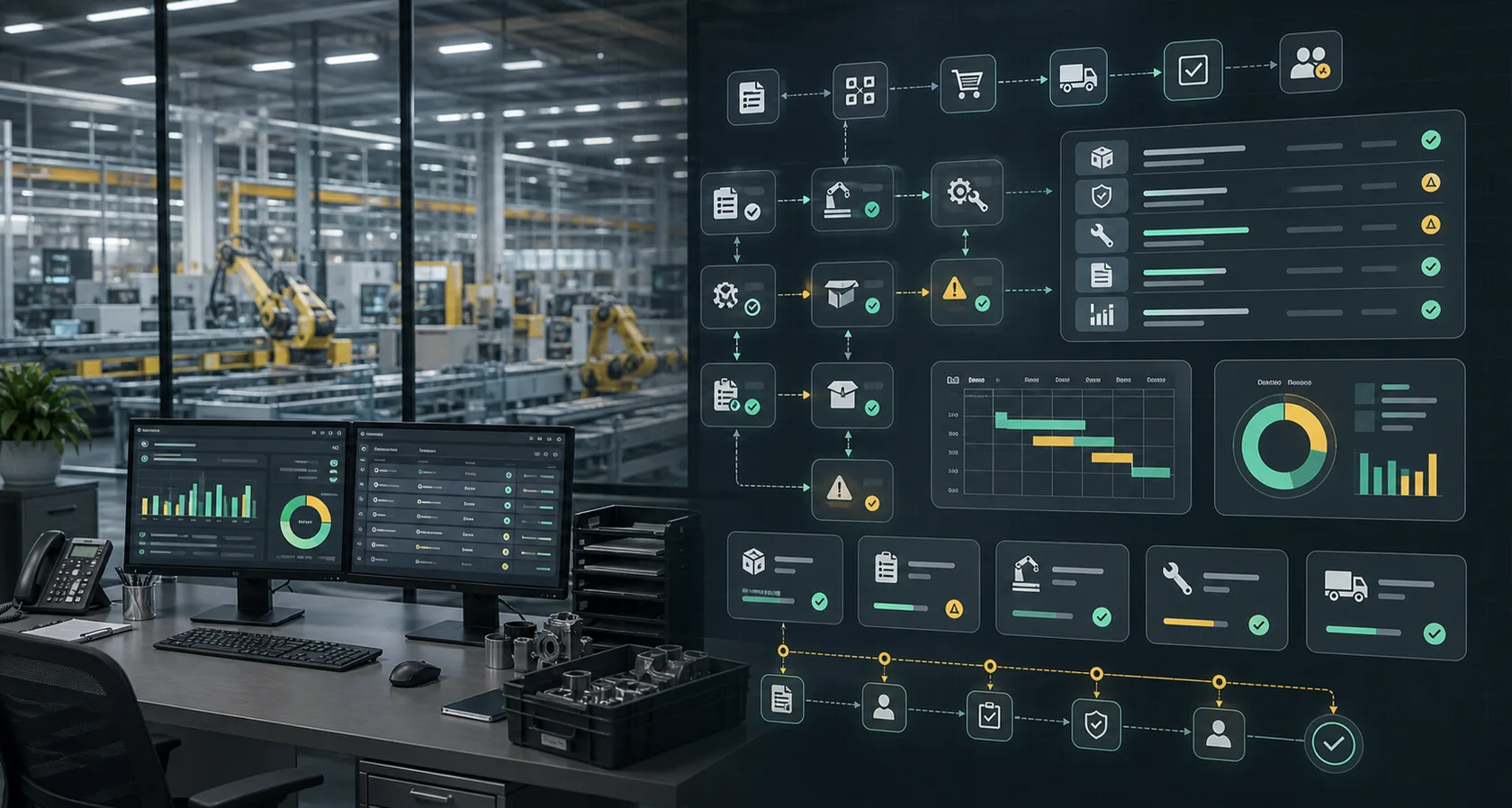
Factory workflow model
The manufacturing design reads like a plant operations board: production orders, QC exceptions, maintenance risk, parts availability, and approval gates are visible in one place.
Capture inspection notes, defect evidence, and corrective-action tasks.
Prioritize machine alerts, work orders, spare parts, and technician routing.
Flag shortages, purchase-order delays, supplier misses, and stock mismatches.
Hold line changes, customer-impacting updates, and safety-sensitive steps.
Owner problem
Manufacturing automation works best when AI prepares operational context for people who already own the line. The first pilot should reduce queue hunting, missed exceptions, and manual reporting without bypassing supervisor judgment.
Turn inspection photos, nonconformance notes, root-cause clues, and corrective actions into reviewed queues.
Assemble machine alerts, work history, spare-part status, and technician routing before the line stalls.
Flag shortages, supplier delays, purchase-order mismatches, and inventory issues before they become schedule problems.
How we help
Map line signals: Document where QC notes, work orders, inventory records, production schedules, and supplier updates get delayed.
Prepare review context: Use AI to summarize exceptions, attach source evidence, draft tasks, and route work to the right owner.
Protect operations: Require supervisor approval for quality dispositions, schedule-impacting changes, safety-sensitive work, and customer commitments.
Example case
The first implementation should be narrow enough to launch quickly and important enough to prove ROI. This example shows the kind of workflow we would validate during the consultation.
Problem: Supervisors lose time when defect notes, machine alerts, work orders, inventory records, and schedule risks sit across MES, ERP, spreadsheets, email, and whiteboards.
Automation: AI gathers exception context, attaches source evidence, drafts the work queue, highlights missing parts or approvals, and routes tasks to the responsible owner.
Guardrail: Quality dispositions, production schedule changes, safety-sensitive maintenance, and customer commitments remain supervisor-approved.
ROI model
Manufacturing AI workflow ROI should be visible in operating metrics the plant already understands.
Time from defect, work order, shortage, or schedule risk detected to reviewed owner action.
Maintenance risks surfaced before failure, plus work orders with parts, history, and owner context ready.
Quality issues routed with better evidence, repeat defect patterns, and corrective-action follow-through.
Manual lookups, report prep, status chasing, and queue cleanup removed from shift leaders.
Long term, the factory gets a guarded operations layer across MES, ERP, CMMS, quality systems, spreadsheets, supplier updates, line dashboards, and supervisor approval queues.
Fees
Start narrow, prove the workflow, then move to managed optimization only if the numbers work.
$2K-$5K
Plant workflow map, systems inventory, exception-volume review, risk matrix, and pilot ROI estimate.
$12K-$40K
One quality, maintenance, inventory, or scheduling workflow with integrations, approvals, and logs.
$5K-$18K/mo
Monitoring, exception tuning, integration support, supervisor feedback, reporting, and expansion planning.
FAQ
Short answers for owners and operators deciding whether an AI workflow pilot is worth scoping.
Start with a repeated queue that already has measurable volume and owner review, such as quality exceptions, maintenance work orders, inventory shortages, purchase-order delays, or production schedule risk summaries.
AI should prepare context, draft tasks, and surface risks. Quality dispositions, schedule-impacting changes, safety-sensitive maintenance, and customer commitments should stay supervisor-approved.
Useful metrics include exception closure time, downtime avoided, rework reduction, supervisor hours saved, parts availability, schedule-risk response, and the correction rate on AI-prepared work.
Workflow guides
Deeper pages for specific workflows, search intent, integrations, guardrails, and measurable ROI.
Build manufacturing quality control AI workflow automation for defect reports, inspection evidence, nonconformance routing, corrective actions, supervisor approval, and ROI reporting.
ManufacturingManufacturing Maintenance Work Order AI Workflow AutomationBuild manufacturing maintenance work order AI workflow automation for machine alerts, downtime risk, spare parts, technician routing, supervisor approval, and maintenance ROI.
Services
Connect the industry page to the commercial services that plan the workflow, build the guarded pilot, define approval controls, and measure ROI.
AI workflow automation consulting for businesses that need workflow mapping, AI agent implementation, human approval guardrails, and measurable ROI reporting.
Workflow implementationAI Workflow Automation ImplementationAI workflow automation implementation for businesses ready to turn one mapped workflow into AI agents, integrations, approval queues, launch support, and ROI reporting.
Automation guardrailsAI Automation GuardrailsDesign AI automation guardrails for business workflows with approval rules, source evidence, audit logs, permissions, fallback handling, and exception queues.
ROI auditAI Workflow ROI AuditAI workflow ROI audit for businesses that need to identify the first automation pilot, estimate value, rank workflows, and avoid low-ROI AI projects.
Implementation plan