Work order readiness
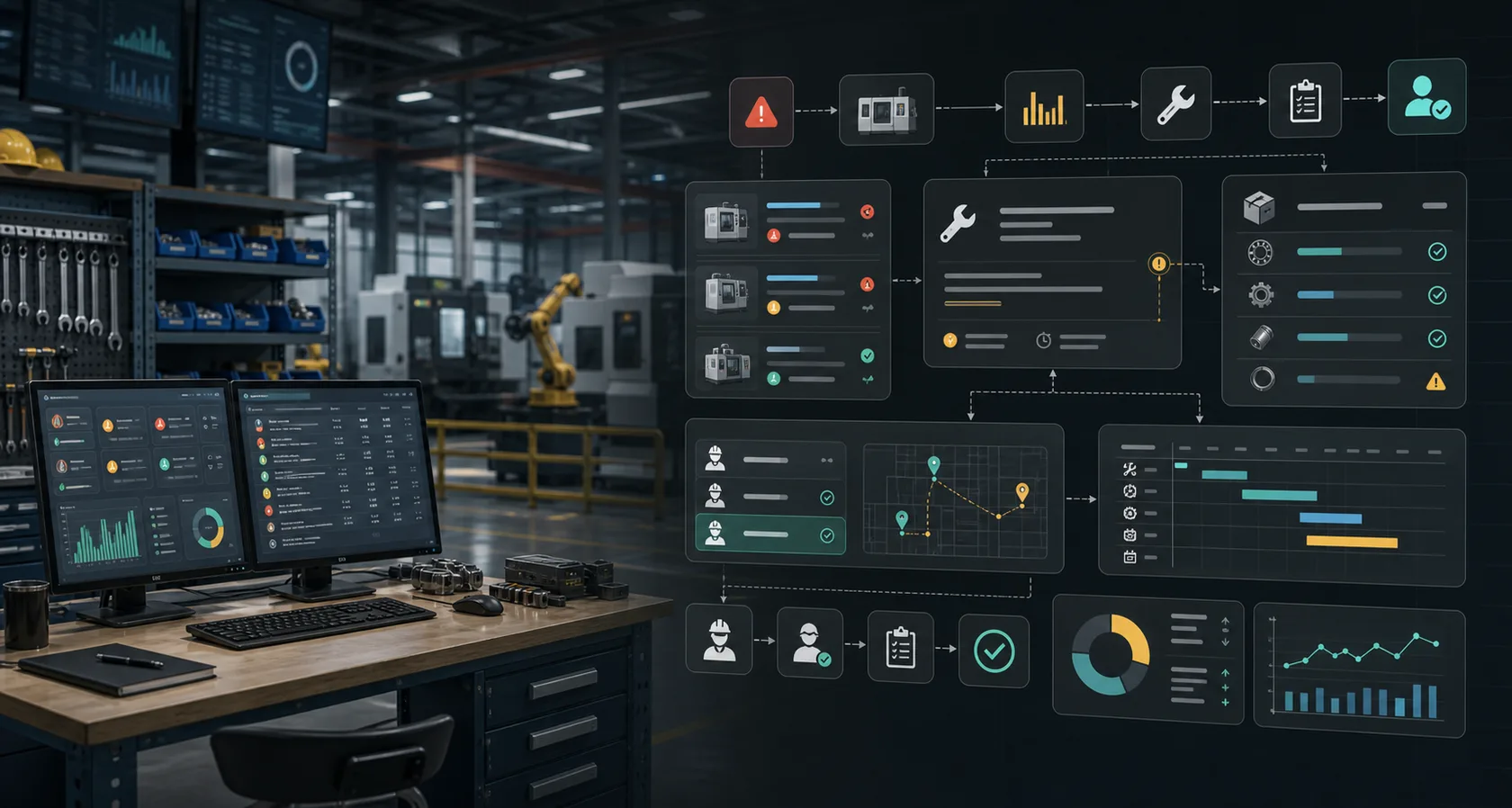
Maintenance tasks with machine context, parts status, priority, technician owner, and source evidence ready for review.
Manufacturing use case
Build manufacturing maintenance work order AI workflow automation for machine alerts, downtime risk, spare parts, technician routing, supervisor approval, and maintenance ROI.
Search intent
Maintenance work slows down when machine alerts, operator notes, work history, spare parts, downtime risk, technician availability, and schedule impact are scattered across CMMS, ERP, and spreadsheets.
Workflow design
The first project should be narrow, measurable, and tied to a clear approval boundary.
Collect machine context: Gather alerts, operator notes, asset history, recent maintenance, downtime risk, related quality issues, and production schedule impact.
Check parts and priority: Attach spare-part availability, purchase needs, technician skills, severity, line dependency, and recommended owner.
Prepare work queue: Draft work orders, escalation notes, parts requests, technician routes, and supervisor review tasks.
Track reliability signals: Measure downtime risk surfaced, work order completion, repeat failures, parts blockers, and supervisor corrections.
Systems involved
The implementation plan starts by identifying source systems, owners, permissions, and the exact handoff AI is allowed to prepare.
ROI signals
Ranking the first workflow by ROI makes the page useful for buyers and clearer for search engines.
Maintenance tasks with machine context, parts status, priority, technician owner, and source evidence ready for review.
Time from alert or operator note to reviewed work order, assigned technician, or escalation.
Spare-part shortages, purchase needs, supplier delays, and inventory mismatches surfaced before technicians wait.
FAQ
Short answers for teams deciding whether this AI workflow is worth scoping.
AI can prepare work orders, summarize machine alerts, attach parts context, and route tasks, but safety-sensitive work, line shutdowns, and schedule changes should stay supervisor-approved.
Common systems include CMMS, MES, ERP, machine alert feeds, parts inventory, scheduling tools, spreadsheets, and technician task queues.
Track work order readiness, downtime response time, parts blockers, repeat failures, technician wait time, supervisor corrections, and avoided downtime.
Services
Use-case research should connect to implementation support: workflow consulting, build scope, approval guardrails, and ROI validation.
AI workflow automation consulting for businesses that need workflow mapping, AI agent implementation, human approval guardrails, and measurable ROI reporting.
Workflow implementationAI Workflow Automation ImplementationAI workflow automation implementation for businesses ready to turn one mapped workflow into AI agents, integrations, approval queues, launch support, and ROI reporting.
Automation guardrailsAI Automation GuardrailsDesign AI automation guardrails for business workflows with approval rules, source evidence, audit logs, permissions, fallback handling, and exception queues.
ROI auditAI Workflow ROI AuditAI workflow ROI audit for businesses that need to identify the first automation pilot, estimate value, rank workflows, and avoid low-ROI AI projects.
Pricing path
The buying path should match the evidence available: start with consultation when the workflow is unclear, use an ROI audit when cost or readiness is uncertain, and move to a guarded pilot only when the owner, data, approvals, and baseline metrics are ready.
Implementation plan
We will review your current tools, map the approval boundary, and recommend whether this workflow is worth implementing first.