Load intake
Capture lane, commodity, equipment, pickup window, delivery window, accessorials, and customer constraints.
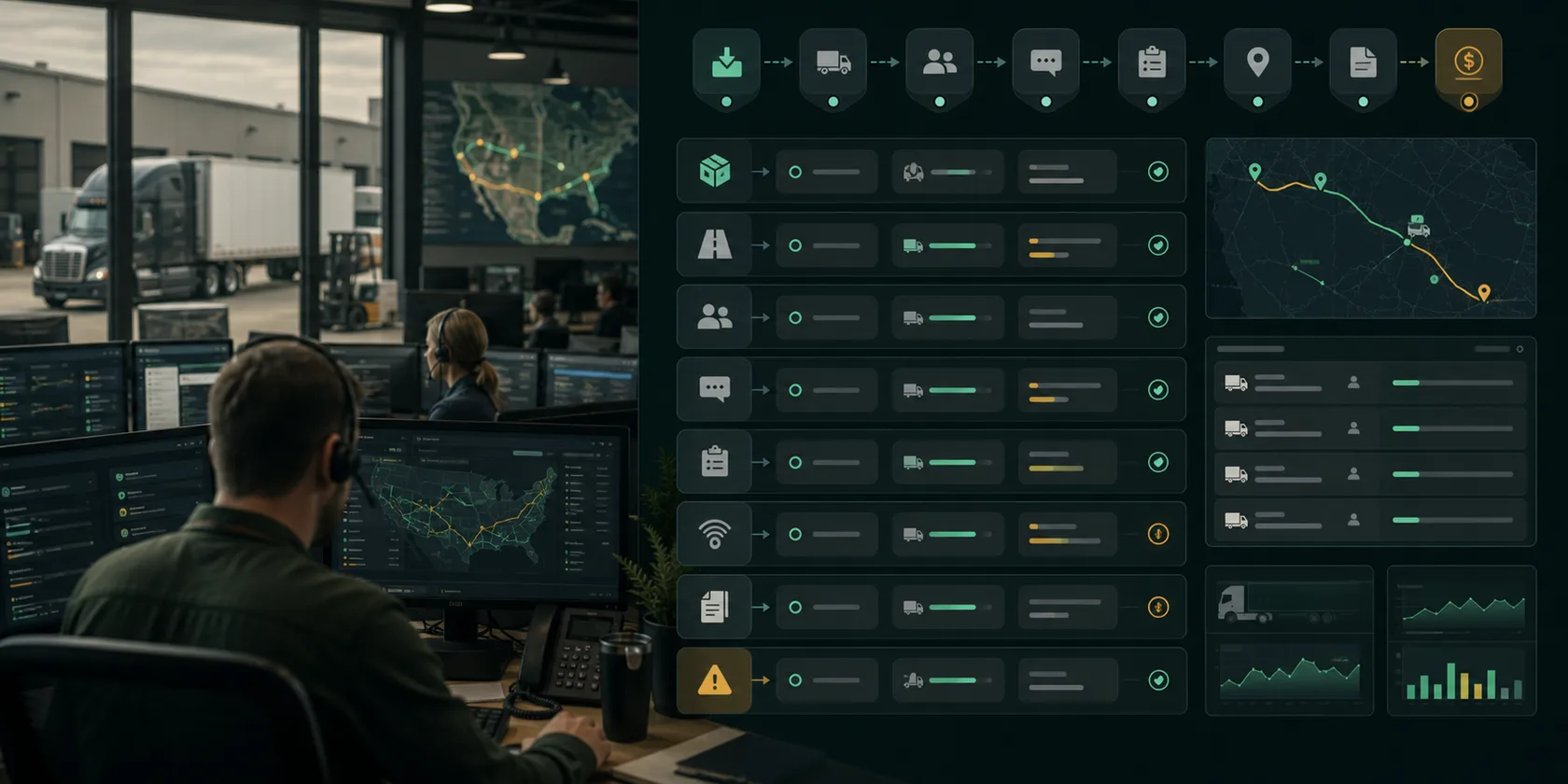
Freight brokerage operations
Automate freight brokers: load intake, carrier sales, quote follow-up, tender status, track-and-trace, POD evidence, margin guardrails, ROI, and pricing.
Freight brokerage desk
The freight brokerage design feels like a dispatch and load board desk: shipper requests, lane notes, carrier outreach, tender follow-up, track-and-trace, invoice evidence, and margin exceptions stay visible without letting automation make unreviewed price or service commitments.
Capture lane, commodity, equipment, pickup window, delivery window, accessorials, and customer constraints.
Queue carrier outreach, capacity notes, compliance checks, dispatcher notes, and rate review tasks.
Draft shipper updates, tender reminders, appointment notes, check calls, and escalation summaries.
Route rate changes, carrier commitments, detention, claims, service failures, and customer promises.
Owner problem
Freight broker AI automation works best when it prepares dispatcher, carrier sales, account manager, and billing work instead of making unreviewed pricing, carrier commitment, claims, or customer-service promises. The first pilot should reduce stale carrier outreach, missed quote follow-up, manual check calls, and invoice/POD chasing while keeping margin-sensitive actions approved.
Classify shipper requests, lane notes, equipment type, appointment windows, accessorials, and missing load details.
Queue carrier sales tasks, capacity notes, compliance status, preferred carrier matches, and dispatcher review.
Hold rate changes, carrier commitments, detention, claims, missed appointments, and customer promises for approval.
How we help
Map brokerage handoffs: Document where shipper inboxes, TMS records, load boards, carrier databases, email, SMS, phone notes, ELD pings, and billing files slow down.
Prepare reviewed actions: Use AI to classify load requests, summarize lane requirements, draft carrier outreach, prepare quote follow-up, and route exceptions.
Protect margin risk: Require approval for rate changes, carrier selection, service commitments, claims language, detention disputes, accessorial promises, and customer-impacting updates.
Example case
The first implementation should be narrow enough to launch quickly and important enough to prove ROI. This example shows the kind of workflow we would validate during the consultation.
Problem: Freight brokers move between shipper email, TMS, load boards, carrier databases, phone notes, ELD updates, invoice documents, and customer exceptions while coverage speed and margin keep changing.
Automation: AI classifies load requests, extracts lane requirements, prepares carrier outreach, drafts quote and tender follow-up, summarizes shipment exceptions, and attaches POD or accessorial evidence.
Guardrail: Rate changes, carrier selection, customer commitments, detention or accessorial disputes, claims language, service-failure messages, and margin-impacting actions remain broker or manager-reviewed.
ROI model
Freight broker AI workflow ROI should show up in faster load intake, fewer stale carrier outreach tasks, better tender follow-up, cleaner exception handling, and less manual POD or invoice chasing.
Time from shipper request or uncovered load to reviewed carrier outreach, capacity summary, dispatcher handoff, or coverage decision.
Time from quote request, tender, or shipper question to reviewed reply, missing-detail request, or escalation.
Manual status lookups, appointment checks, late-risk summaries, and customer update drafts reduced per active load.
Loads with rate changes, detention, accessorials, claims risk, late fees, or invoice variance routed for review.
Long term, the freight broker gets a guarded operations layer across TMS, load boards, carrier databases, CRM, email, SMS, phone notes, ELD visibility tools, document storage, accounting, and approval queues.
Fees
Start narrow, prove the workflow, then move to managed optimization only if the numbers work.
$1K-$3.5K
Brokerage workflow map, TMS and load board review, load volume model, approval boundary, margin-risk map, and pilot ROI estimate.
$7K-$30K
One load intake, carrier sales, quote follow-up, tender status, track-and-trace, POD, or invoice evidence workflow with integrations and logs.
$3K-$14K/mo
Monitoring, lane and seasonality tuning, dispatcher feedback, carrier outreach improvements, exception reporting, and expansion planning.
FAQ
Short answers for owners and operators deciding whether an AI workflow pilot is worth scoping.
Start with a repeated brokerage queue such as load intake, carrier outreach, quote follow-up, tender status, check calls, POD collection, invoice evidence, or margin exception routing.
AI can prepare carrier options, capacity notes, outreach drafts, and rate context, but carrier selection, rate changes, customer commitments, claims, detention, and margin-impacting actions should stay reviewed.
Useful metrics include coverage cycle time, quote follow-up speed, check-call touches, load status accuracy, POD collection time, invoice exceptions, margin variance, and correction rate.
Workflow guides
Deeper pages for specific workflows, search intent, integrations, guardrails, and measurable ROI.
Build freight broker carrier sales AI workflow automation for load coverage, carrier outreach, compliance checks, lane notes, dispatcher review, and margin reporting.
Freight BrokersFreight Quote and Tender Follow-Up AI Workflow AutomationBuild freight quote and tender follow-up AI workflow automation for shipper requests, missing details, tender reminders, check calls, exceptions, and ROI reporting.
Services
Connect the industry page to the commercial services that plan the workflow, build the guarded pilot, define approval controls, and measure ROI.
AI workflow automation consulting for businesses that need workflow mapping, AI agent implementation, human approval guardrails, and measurable ROI reporting.
Workflow implementationAI Workflow Automation ImplementationAI workflow automation implementation for businesses ready to turn one mapped workflow into AI agents, integrations, approval queues, launch support, and ROI reporting.
Automation guardrailsAI Automation GuardrailsDesign AI automation guardrails for business workflows with approval rules, source evidence, audit logs, permissions, fallback handling, and exception queues.
ROI auditAI Workflow ROI AuditAI workflow ROI audit for businesses that need to identify the first automation pilot, estimate value, rank workflows, and avoid low-ROI AI projects.
Implementation plan