Borrower intake
Capture goals, loan purpose, property context, timeline, contact preferences, and missing fields.
Mortgage operations
Automate mortgage brokers and loan officers: borrower intake, document collection, loan status follow-up, conditions, disclosure-sensitive review, ROI, and pricing.
Mortgage broker model
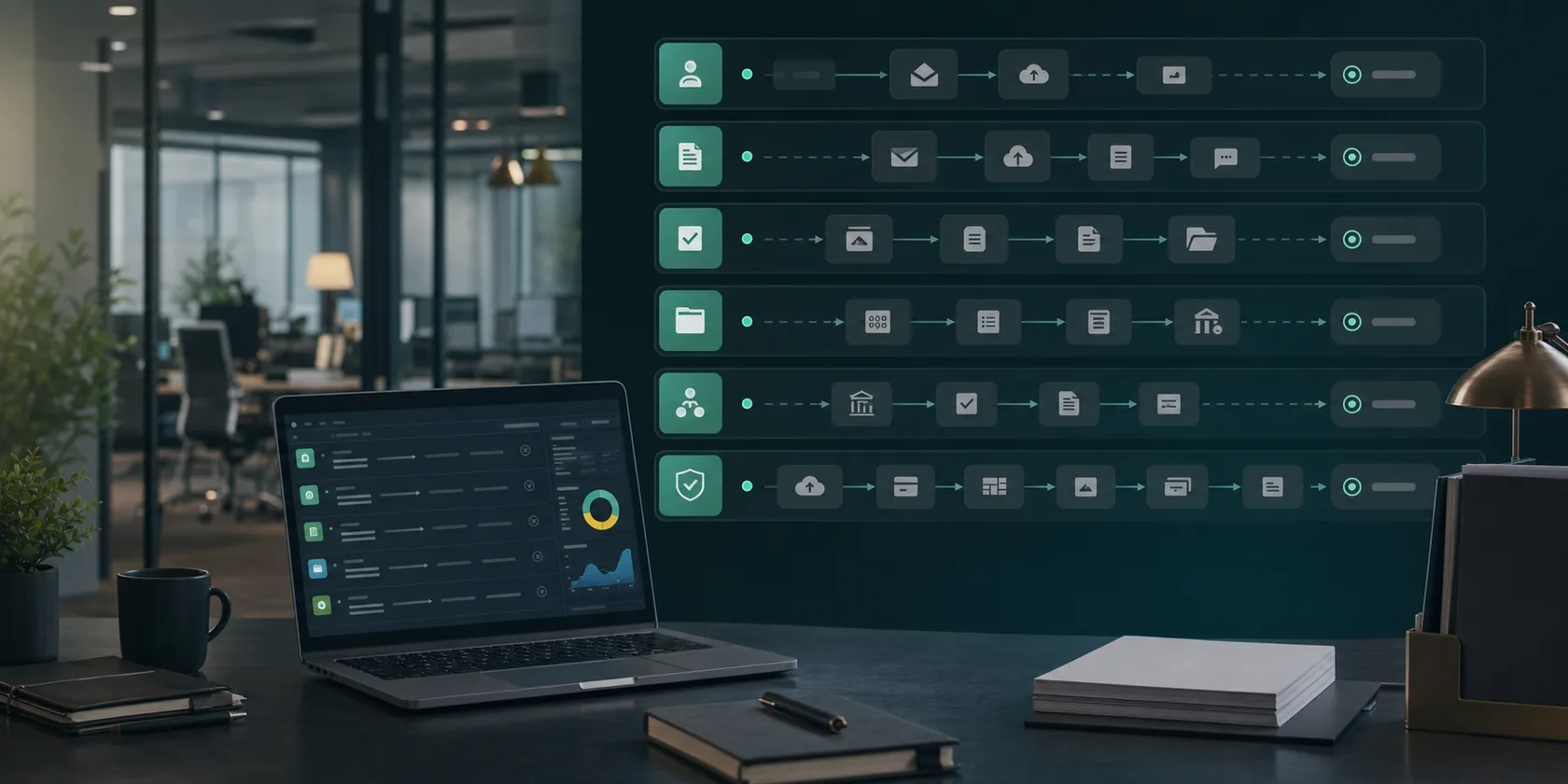
The mortgage design feels like a loan operations board: borrower intake, document status, milestone updates, condition follow-up, processor tasks, and loan officer approvals stay coordinated without letting automation make underwriting or pricing decisions.
Capture goals, loan purpose, property context, timeline, contact preferences, and missing fields.
Track pay stubs, bank statements, IDs, tax forms, disclosures, conditions, and upload status.
Draft milestone updates, reminder messages, referral nudges, and processor handoffs.
Route rate, approval, denial, eligibility, fair-lending, and disclosure-sensitive language.
Owner problem
Mortgage AI automation works best when it prepares loan officer, processor, and compliance-reviewed work instead of making pricing, eligibility, approval, denial, or underwriting decisions alone. The first pilot should reduce stale borrower follow-up, missing documents, slow condition collection, and repetitive status updates while preserving review control.
Classify borrower goals, attach loan context, flag missing application fields, and queue next-step tasks.
Track requested documents, upload status, condition age, disclosure packet status, and processor review.
Draft reviewed milestone updates, reminder messages, referral prompts, and handoff notes.
How we help
Map loan handoffs: Document where CRM leads, LOS files, document portals, pricing tools, disclosures, processor queues, and borrower messages slow down.
Prepare reviewed work: Use AI to classify borrower requests, attach source context, draft reminders, summarize missing documents, and queue condition follow-up.
Protect lending risk: Require approval for rates, APR language, eligibility claims, approval or denial language, underwriting conditions, disclosures, and fair-lending-sensitive communication.
Example case
The first implementation should be narrow enough to launch quickly and important enough to prove ROI. This example shows the kind of workflow we would validate during the consultation.
Problem: Mortgage teams move between CRM leads, LOS records, document portals, email, SMS, pricing tools, disclosure packets, processor notes, and borrower questions while loan timelines keep moving.
Automation: AI classifies borrower context, tracks missing documents, prepares condition follow-up, drafts milestone messages, flags disclosure-sensitive language, and routes loan-impacting decisions for review.
Guardrail: Rates, APR language, eligibility claims, approvals, denials, underwriting judgments, disclosure language, and fair-lending-sensitive messages remain loan officer or compliance-reviewed.
ROI model
Mortgage AI workflow ROI should show up in faster borrower response, fewer missing-document delays, cleaner condition collection, and less repetitive status-update work.
Loan files with required documents, upload status, missing-item notes, disclosure status, and processor review status ready.
Time from condition request or missing document to reviewed borrower reminder, upload, or processor escalation.
Time from borrower question, lead, document gap, or milestone to reviewed reply, next-step task, or escalation.
Manual note lookup, document chasing, status drafting, reminder creation, and handoff work reduced per file.
Long term, the mortgage broker gets a guarded operations layer across CRM, LOS, document portals, email, SMS, phone, calendar, pricing tools, disclosure systems, e-sign tools, and approval queues.
Fees
Start narrow, prove the workflow, then move to managed optimization only if the numbers work.
$1K-$3.5K
Mortgage workflow map, LOS and CRM review, borrower and document volume model, approval boundary, and pilot ROI estimate.
$7K-$28K
One borrower intake, document collection, condition follow-up, loan status, referral, or processor handoff workflow with integrations and logs.
$3K-$12K/mo
Monitoring, market-cycle tuning, borrower communication support, reporting, reviewer feedback, and expansion planning.
FAQ
Short answers for owners and operators deciding whether an AI workflow pilot is worth scoping.
Start with a repeated loan officer or processor queue such as borrower intake, document collection, condition follow-up, loan status updates, referral follow-up, or missing-item reminders.
AI can prepare context, draft reminders, and queue review tasks, but rates, APR language, eligibility claims, approvals, denials, underwriting judgments, disclosure language, and fair-lending-sensitive messages should stay reviewed.
Useful metrics include document readiness, condition age, borrower response time, missing-item completion, loan officer touches, milestone delays, referral follow-up, and correction rate.
Workflow guides
Deeper pages for specific workflows, search intent, integrations, guardrails, and measurable ROI.
Build mortgage borrower document collection AI workflow automation for pay stubs, bank statements, tax forms, IDs, conditions, disclosure status, loan officer approval, and ROI reporting.
Mortgage BrokersMortgage Loan Officer Follow-Up AI Workflow AutomationBuild mortgage loan officer follow-up AI workflow automation for borrower status updates, conditions, referral follow-up, milestone reminders, review queues, and ROI reporting.
Services
Connect the industry page to the commercial services that plan the workflow, build the guarded pilot, define approval controls, and measure ROI.
AI workflow automation consulting for businesses that need workflow mapping, AI agent implementation, human approval guardrails, and measurable ROI reporting.
Workflow implementationAI Workflow Automation ImplementationAI workflow automation implementation for businesses ready to turn one mapped workflow into AI agents, integrations, approval queues, launch support, and ROI reporting.
Automation guardrailsAI Automation GuardrailsDesign AI automation guardrails for business workflows with approval rules, source evidence, audit logs, permissions, fallback handling, and exception queues.
ROI auditAI Workflow ROI AuditAI workflow ROI audit for businesses that need to identify the first automation pilot, estimate value, rank workflows, and avoid low-ROI AI projects.
Implementation plan