Property intake
Capture address context, service type, photos, measurements, access notes, budget range, seasonality, and preferred timing.
Landscape operations
Automate landscaping companies: lead intake, estimates, crew scheduling, recurring lawn routes, maintenance renewals, guardrails, ROI, and pricing.
Landscaping model
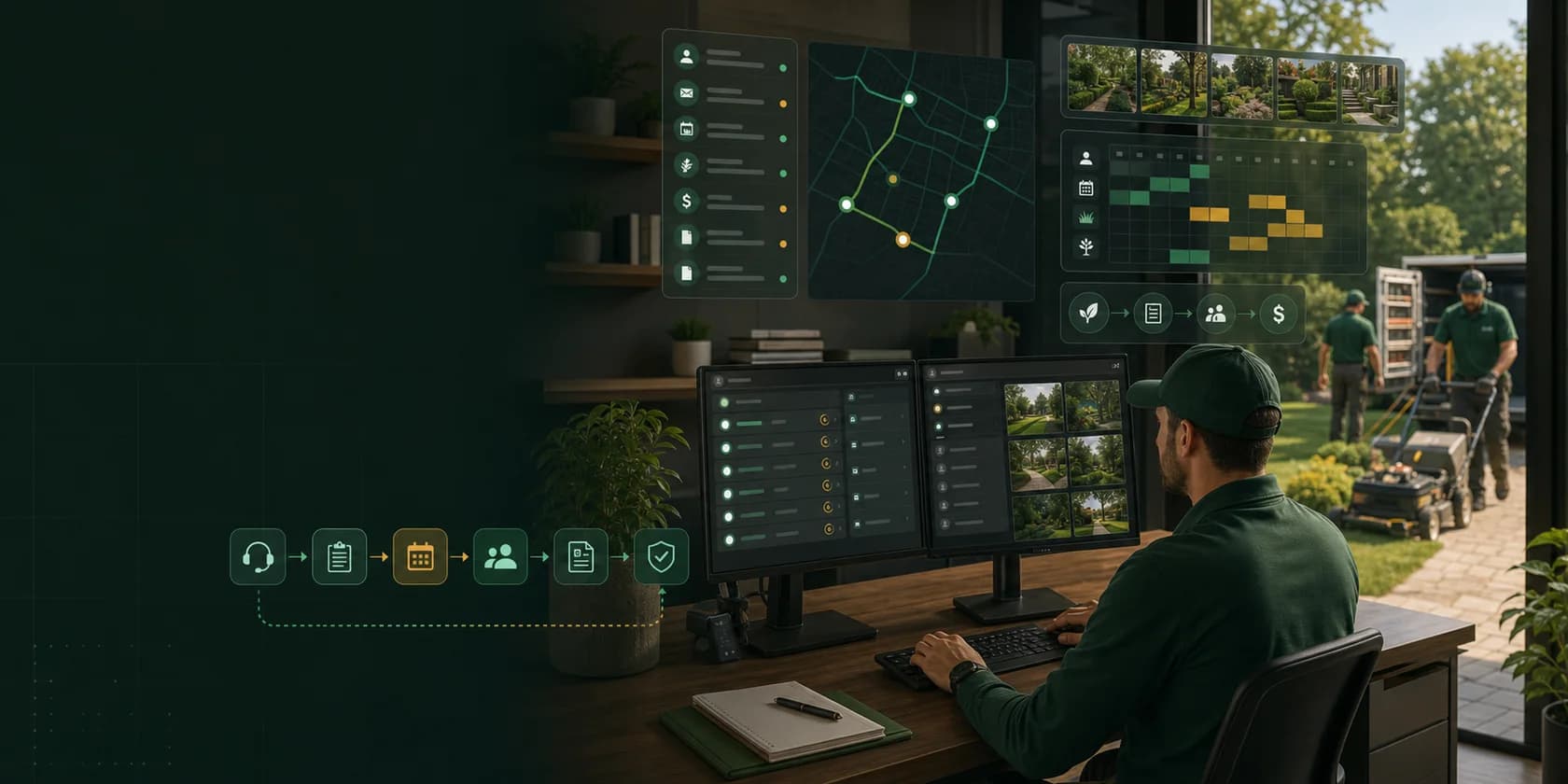
The landscaping design feels like a crew and job-cost command board: web leads, property photos, site notes, estimate tasks, route boards, seasonal service calendars, maintenance agreements, enhancement requests, invoices, and approval queues stay visible while automation avoids unreviewed pricing, scope, chemical, safety, drainage, warranty, or guarantee claims.
Capture address context, service type, photos, measurements, access notes, budget range, seasonality, and preferred timing.
Prepare site summaries, scope options, material context, follow-up tasks, customer objections, and manager review packets.
Queue route windows, crew assignments, weather notes, recurring lawn care, cleanup tasks, and customer updates.
Move maintenance renewals, seasonal services, enhancement opportunities, invoice handoffs, and review requests.
Owner problem
Landscaping AI automation works best when it prepares estimator, scheduler, crew lead, and owner-reviewed work instead of making unapproved scope, pricing, chemical, safety, drainage, warranty, guarantee, or property-damage decisions. The first pilot should reduce slow estimate follow-up, route admin, missed renewals, crew handoff gaps, and back-office touches while keeping owner control.
Classify mowing, fertilization, cleanup, irrigation, hardscape, enhancement, maintenance, commercial, HOA, or emergency intent.
Attach property context, access notes, photos, recurring service status, weather notes, route sequence, and arrival tasks.
Prepare maintenance renewal reminders, seasonal cleanup prompts, enhancement follow-up, invoice handoffs, and review requests.
How we help
Map estimate and route queues: Document where phone, web forms, CRM, estimating tools, route boards, crew notes, weather updates, invoices, and review platforms slow the team down.
Prepare reviewed work: Use AI to classify service intent, summarize property context, draft follow-up, prepare route handoffs, and queue renewal or enhancement tasks.
Protect scope and safety: Require review for scope changes, pricing, chemical or fertilizer language, safety issues, drainage claims, warranties, guarantees, and customer-facing commitments.
Example case
The first implementation should be narrow enough to launch quickly and important enough to prove ROI. This example shows the kind of workflow we would validate during the consultation.
Problem: Landscaping teams move between phone calls, web forms, CRM, estimate tools, route boards, crew notes, weather changes, photos, maintenance agreements, invoices, and review platforms while customers expect fast follow-up.
Automation: AI classifies landscape intent, prepares property and estimate context, summarizes crew notes, drafts reviewed customer updates, queues route tasks, surfaces agreement renewals, and attaches job closeout evidence.
Guardrail: Scope changes, pricing, chemical or fertilizer language, safety claims, drainage statements, warranty promises, guarantees, refunds, and customer-facing commitments remain estimator, manager, or owner-reviewed.
ROI model
Landscaping AI workflow ROI should show up in faster lead response, cleaner estimate packets, fewer manual scheduling touches, steadier recurring route coverage, more consistent renewal follow-up, and fewer missed customer updates.
Time from missed call, form, voicemail, referral, or commercial request to reviewed estimate task, reply, or route queue.
Opportunities with service type, property photos, access notes, measurements, scope context, material hints, and reviewer action ready.
Jobs with route sequence, crew assignment, weather note, service history, recurring status, property access, and customer update prepared.
Maintenance agreements, seasonal cleanups, enhancement opportunities, skipped services, and expired accounts with reviewed reminders prepared.
Long term, the landscaping company gets a guarded operations layer across phone, forms, CRM, estimating tools, scheduling boards, route apps, crew notes, photo uploads, weather updates, invoices, review platforms, and approval queues.
Fees
Start narrow, prove the workflow, then move to managed optimization only if the numbers work.
$1K-$3.5K
Landscaping workflow map, estimating and route review, lead and recurring service volume model, approval boundary, and pilot ROI estimate.
$7K-$30K
One lead intake, estimate, crew scheduling, recurring lawn route, maintenance renewal, invoice, or review workflow with integrations and logs.
$3K-$13K/mo
Monitoring, seasonal tuning, estimator and crew feedback, renewal reporting, route workflow improvements, and expansion planning.
FAQ
Short answers for owners and operators deciding whether an AI workflow pilot is worth scoping.
Start with a repeated queue such as lead intake, estimate follow-up, crew scheduling, recurring lawn route prep, maintenance renewal reminders, seasonal cleanup follow-up, invoice handoff, or review requests.
AI can prepare context, summaries, and drafts, but pricing, scope changes, chemical or fertilizer language, drainage claims, safety issues, warranties, guarantees, and customer commitments should stay estimator or owner-reviewed.
Useful metrics include lead response speed, estimate readiness, follow-up speed, crew route readiness, maintenance renewal movement, office touches removed, invoice handoff speed, and correction rate.
Workflow guides
Deeper pages for specific workflows, search intent, integrations, guardrails, and measurable ROI.
Build landscaping estimate and crew scheduling AI workflow automation for property lead intake, photos, scope prep, proposal follow-up, crew assignment, route handoffs, and ROI reporting.
LandscapingLawn Care Recurring Service Route AI Workflow AutomationBuild lawn care recurring service route AI workflow automation for recurring mowing, fertilization, seasonal cleanups, skipped visits, renewal reminders, route updates, and ROI reporting.
Services
Connect the industry page to the commercial services that plan the workflow, build the guarded pilot, define approval controls, and measure ROI.
AI workflow automation consulting for businesses that need workflow mapping, AI agent implementation, human approval guardrails, and measurable ROI reporting.
Workflow implementationAI Workflow Automation ImplementationAI workflow automation implementation for businesses ready to turn one mapped workflow into AI agents, integrations, approval queues, launch support, and ROI reporting.
Automation guardrailsAI Automation GuardrailsDesign AI automation guardrails for business workflows with approval rules, source evidence, audit logs, permissions, fallback handling, and exception queues.
ROI auditAI Workflow ROI AuditAI workflow ROI audit for businesses that need to identify the first automation pilot, estimate value, rank workflows, and avoid low-ROI AI projects.
Implementation plan