Referral intake
Track exam order, referring provider, modality, body part, diagnosis context for review, insurance, and missing documents.
Radiology operations
Automate diagnostic imaging and radiology centers: referral intake, exam scheduling, prior authorization, patient prep, report routing, billing, guardrails, ROI, and pricing.
Radiology workflow model
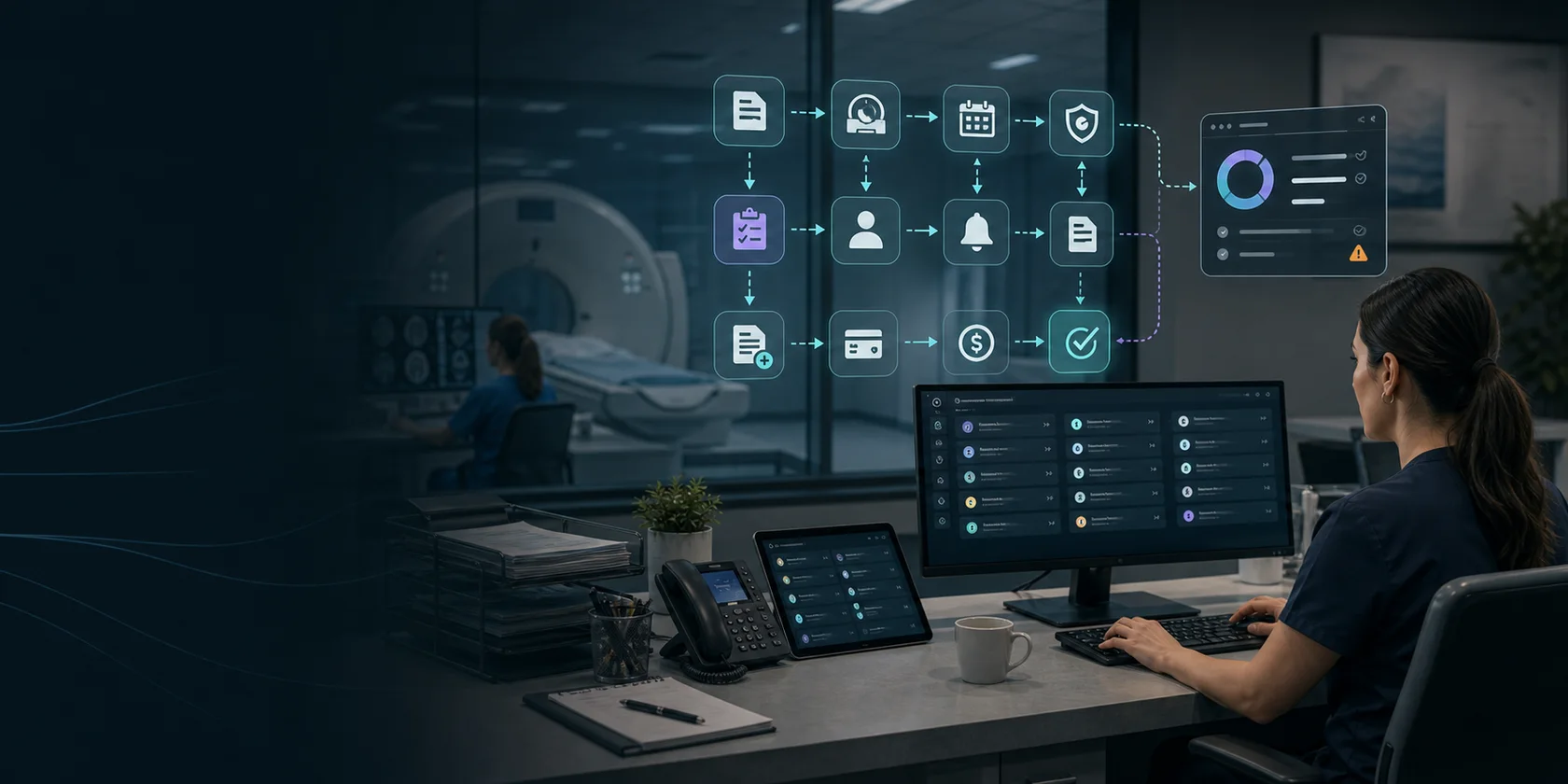
The imaging center design feels like a radiology operations console: referral orders, modality, body part, insurance, prior authorization, patient prep, reminders, MRI safety screening tasks, contrast-question routing, report status, critical-result workflows, referring-provider messages, claims, denials, and approval queues stay visible while automation avoids unreviewed image interpretation, clinical advice, MRI clearance, contrast instructions, critical findings, coding finalization, or payer commitments.
Track exam order, referring provider, modality, body part, diagnosis context for review, insurance, and missing documents.
Prepare appointment options, modality-specific prep tasks, reminders, MRI screening status, authorization, and staff owner.
Queue report status, referring-provider delivery, critical-result workflows, follow-up tasks, and radiologist or clinician review.
Organize eligibility, prior authorization, claim status, denials, payments, estimate questions, and billing owner.
Owner problem
Radiology AI automation works best when it prepares scheduler, technologist, radiologist, billing, and manager-reviewed work instead of interpreting images, clearing safety risks, giving clinical advice, changing orders, coding claims, or promising coverage. The first pilot should reduce slow referral intake, missing order details, authorization backlog, patient prep friction, report-status calls, claim denials, and repetitive provider follow-up while preserving clinical control.
Classify exam orders, modality, body part, referring provider, insurance, missing documents, and scheduler action.
Attach appointment options, prep tasks, MRI screening status, contrast-question routing, reminders, and authorization status.
Queue report status, critical-result routing, provider delivery, claim exceptions, denials, payments, and owner action.
How we help
Map referral, clinical, and revenue handoffs: Document where referring offices, phone, fax, web forms, RIS, PACS, EHR, scheduling, patient portal, payer portals, clearinghouse, SMS, and email slow the center down.
Prepare reviewed radiology work: Use AI to classify referral orders, assemble scheduling and authorization context, draft reviewed patient or referring-office updates, and queue report, billing, technologist, or manager review work.
Protect clinical and safety boundaries: Require review for image interpretation, critical results, MRI safety, contrast questions, medication guidance, order changes, coding changes, payer commitments, and sensitive patient messages.
Example case
The first implementation should be narrow enough to launch quickly and important enough to prove ROI. This example shows the kind of workflow we would validate during the consultation.
Problem: Radiology teams move between referring offices, phone, fax, web forms, RIS, PACS, EHR, calendars, patient portal, payer portals, clearinghouse, SMS, and email while patients and providers expect fast scheduling and report updates.
Automation: AI classifies referral orders, prepares scheduling and authorization context, queues missing documents, drafts reviewed patient or provider follow-up, organizes report-status tasks, and routes billing, technologist, radiologist, or manager-review exceptions.
Guardrail: Image interpretation, clinical advice, critical-result communication, MRI safety clearance, contrast instructions, medication questions, order changes, coding finalization, payer commitments, and sensitive patient messages remain radiologist, clinician, technologist, biller, or manager-reviewed.
ROI model
Imaging center AI workflow ROI should show up in faster referral response, more scheduled exams, fewer missing-order delays, quicker authorization movement, better patient prep completion, fewer report-status calls, cleaner claim exceptions, and fewer manual staff touches.
Exam orders with referring provider, modality, body part, payer, missing documents, and scheduling action ready.
Appointment options, prep tasks, reminders, MRI screening status, contrast-question routing, and staff review queues visible.
Report status, critical-result tasks, provider delivery, patient questions, and radiologist or clinician-review queues organized.
Eligibility, authorization, claims, denials, estimates, payments, balances, and billing owner prepared.
Long term, the imaging center gets a guarded operations layer across referring offices, phone, fax, web forms, RIS, PACS, EHR, scheduling, patient portal, payer portals, clearinghouse, payments, SMS, email, and approval queues.
Fees
Start narrow, prove the workflow, then move to managed optimization only if the numbers work.
$1.5K-$4K
Imaging center workflow map, referral and revenue-cycle review, system inventory, approval boundary, and pilot ROI estimate.
$8K-$30K
One referral intake, scheduling, prep reminder, prior authorization, report routing, billing, denial, or provider follow-up workflow with integrations and logs.
$3K-$12K/mo
Monitoring, scheduler and billing feedback, authorization reporting, report-routing review, message tuning, denial queue review, and expansion planning.
FAQ
Short answers for owners and operators deciding whether an AI workflow pilot is worth scoping.
Start with a repeated queue such as referral intake, missing order details, exam scheduling, patient prep reminders, prior authorization prep, report-status routing, critical-result workflow tasks, claim denials, payment follow-up, or referring-provider updates.
No. AI can organize source context and route tasks, but image interpretation, clinical advice, critical-result communication, MRI safety clearance, contrast instructions, medication questions, and order changes should remain radiologist, clinician, technologist, or manager-reviewed.
Useful metrics include referral response time, scheduled exams, missing-order rate, authorization turnaround, prep completion, no-show recovery, report-status call reduction, denial movement, payment follow-up, staff touches removed, and correction rate.
Workflow guides
Deeper pages for specific workflows, search intent, integrations, guardrails, and measurable ROI.
Build radiology referral, exam scheduling, and prior authorization AI workflow automation for orders, missing documents, patient prep, reminders, payer packets, staff review, and ROI reporting.
Imaging CentersImaging Results Follow-Up and Billing AI Workflow AutomationBuild imaging results follow-up and billing AI workflow automation for report status, referring-provider messages, critical-result tasks, claims, denials, payments, staff review, and ROI reporting.
Services
Connect the industry page to the commercial services that plan the workflow, build the guarded pilot, define approval controls, and measure ROI.
AI workflow automation consulting for businesses that need workflow mapping, AI agent implementation, human approval guardrails, and measurable ROI reporting.
Workflow implementationAI Workflow Automation ImplementationAI workflow automation implementation for businesses ready to turn one mapped workflow into AI agents, integrations, approval queues, launch support, and ROI reporting.
Automation guardrailsAI Automation GuardrailsDesign AI automation guardrails for business workflows with approval rules, source evidence, audit logs, permissions, fallback handling, and exception queues.
ROI auditAI Workflow ROI AuditAI workflow ROI audit for businesses that need to identify the first automation pilot, estimate value, rank workflows, and avoid low-ROI AI projects.
Implementation plan