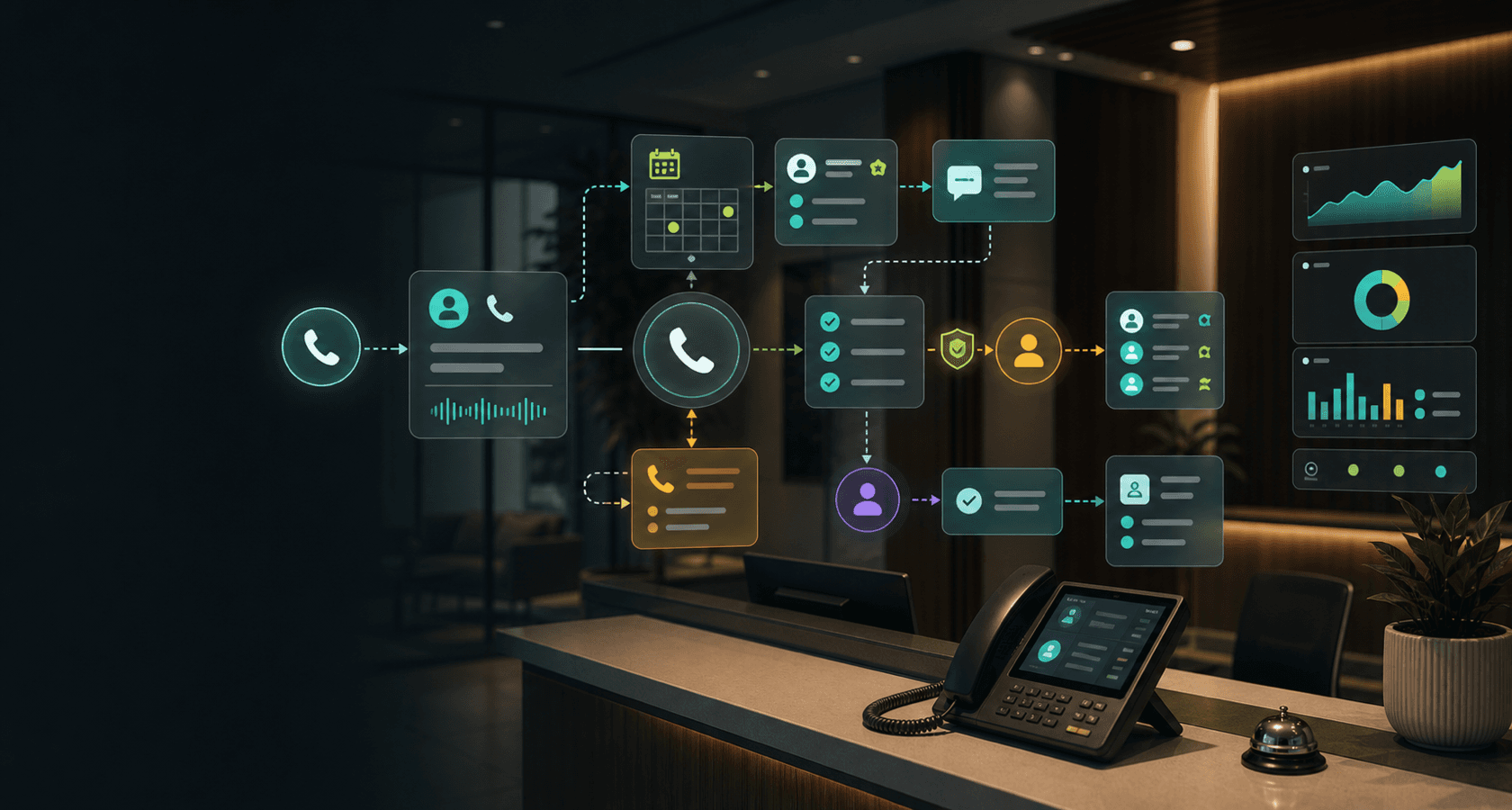
Reception workflow map
Map call types, business hours, missed-call paths, appointment types, lead fields, transfer rules, front desk owners, and CRM or calendar handoffs.
AI automation service
AI receptionist services for missed calls, phone answering, appointment booking, lead intake, call summaries, CRM handoffs, staff escalation, and ROI.
Buyer intent
Small businesses lose revenue when calls hit voicemail, after-hours requests wait until morning, front desk teams juggle intake and scheduling, and call notes never reach the CRM. A generic phone bot can create risk if it books the wrong slot, gives pricing promises, misses urgency, or fails to transfer sensitive conversations.
Deliverables
Every engagement is scoped around concrete work products, clear owners, and decisions your team can review.
Map call types, business hours, missed-call paths, appointment types, lead fields, transfer rules, front desk owners, and CRM or calendar handoffs.
Define greetings, intake questions, answerable FAQs, booking boundaries, prohibited claims, emergency language, fallback phrasing, and transfer prompts.
Prepare appointment options, callback tasks, lead packets, CRM notes, staff notifications, and review queues for pricing, urgency, complaints, or low-confidence calls.
Track answered calls, missed-call recovery, booked appointments, lead capture, callback speed, transfer rate, reviewer edits, and revenue influenced.
Implementation path
Each service starts with the workflow, then narrows into data, approvals, implementation, and measurement.
Choose one reception queue: Start with a narrow phone job such as missed-call recovery, after-hours intake, appointment booking, lead qualification, basic FAQs, or callback routing.
Define safe answers: Separate routine answers from pricing exceptions, refunds, clinical or legal-sensitive questions, emergency requests, complaints, and calls that need staff transfer.
Connect phone and front desk systems: Use least-privilege access to phone, voicemail, SMS, calendar, CRM, intake forms, customer records, and staff notification channels.
Tune from call outcomes: Review transcripts, missed transfers, booking accuracy, staff edits, caller drop-off, lead quality, and revenue outcomes before expanding automation authority.
Buyer checks
High-intent buyers should be able to compare scope, pricing, guardrails, and risk language before booking or approving implementation.
Before buying AI receptionist services, confirm the exact workflow, owner, source systems, sample records, manual volume, and approval risk.
Separate consultation, audit, implementation, integrations, software, managed support, and change-request cost before comparing proposals.
Require allowed actions, blocked actions, approval-required decisions, source evidence, fallback paths, and audit logs before production launch.
Compare the proposal language against public AI risk, security, and implementation references without treating them as a substitute for expert review.
Fit and proof
Use these signals to decide whether a workflow has enough value, repeatability, and control points to automate.
The business receives repeated calls, misses calls during busy or after-hours periods, has clear appointment or lead rules, and knows which calls staff must handle.
Call volume is low, appointment rules are unclear, consent requirements are unknown, or the business wants AI to make medical, legal, financial, pricing, refund, or emergency decisions without review.
More callers reach a useful next step, front desk staff receive cleaner summaries, bookings move faster, and sensitive conversations transfer instead of being mishandled.
FAQ
Short answers for buyers comparing AI automation options, risk, and implementation scope.
AI receptionist services help businesses answer or triage phone calls, recover missed calls, collect caller details, prepare appointment options, summarize conversations, stage CRM or calendar updates, route sensitive calls to staff, and measure front desk ROI.
A phone answering service usually takes messages or transfers calls. An AI receptionist workflow can also qualify intent, prepare booking options, create callback tasks, stage CRM notes, follow approved scripts, and route exceptions with logs.
It can prepare routine booking options after rules are tested, but urgent requests, eligibility issues, sensitive services, pricing commitments, staff conflicts, and low-confidence calls should require staff review or transfer.
Good fits include home services, clinics, dental and therapy offices, med spas, auto repair shops, restaurants, law firms, property managers, and local teams that miss calls or repeat the same intake and booking steps.
Decision support
Buyers can compare how the work is planned, priced, governed, and started before booking a consultation.
Workflow guides
Matched workflow pages help buyers see where this service turns into practical implementation.
Build urgent care online registration and scheduling AI workflow automation for walk-ins, reservations, intake forms, eligibility prep, waitlists, staff review, and ROI reporting.
Auto DealershipsAuto Dealership Service Appointment AI Workflow AutomationBuild auto dealership service appointment AI workflow automation for maintenance requests, recall reminders, advisor handoffs, parts status, warranty flags, customer updates, and ROI reporting.
HVAC ContractorsHVAC Service Dispatch AI Workflow AutomationBuild HVAC service dispatch AI workflow automation for missed calls, no-heat/no-cool urgency, technician routing, equipment notes, arrival updates, and ROI reporting.
RestaurantsRestaurant Reservation and Waitlist AI Workflow AutomationBuild restaurant reservation and waitlist AI workflow automation for calls, online requests, party details, confirmations, no-show recovery, manager approval, and ROI reporting.
Start scoped
The strongest first step is a narrow workflow with clear owners, accessible data, approval rules, and a measurable ROI baseline.